Project Background
Gas turbine is an advanced complete set of power machinery equipment and a typical high-tech intensive product. It represents the comprehensive development level of multiple theoretical disciplines and engineering fields and serves as a pioneering technology of the 21st century. The gas turbine industry integrating new technologies, new materials and new processes has been widely applied in aerospace, ships, petroleum, chemical and other industries. As one of the important symbols of a country’s high-tech level and scientific and technological strength, it occupies a prominent strategic position.
Gas turbine power plants have been extensively adopted thanks to their high thermal efficiency, favorable environmental performance, fast start-stop speed and flexible operation. At present, gas turbine power generation has become an indispensable part of the power structure both in China and worldwide.
1. Power Generation Status of Gas Turbines in Summer
A gas turbine is a constant-volume equipment whose performance is greatly affected by ambient temperature, which is reflected in the following three aspects. First, rising ambient temperature reduces air density and cuts down the mass of air entering the compressor and gas turbine, resulting in lower gas turbine output. Second, higher ambient temperature lowers the compression ratio of the compressor and reduces the work output of the gas turbine. Third, the power consumption of the compressor rises with the increase of ambient temperature, further dragging down the gas turbine output. Generally speaking, every 1°C rise in ambient air temperature will reduce the output of single-shaft gas turbines by 0.5~0.9% and efficiency by 0.2~0.3%.
This temperature characteristic of gas turbines often runs counter to actual demand: higher atmospheric temperature corresponds to greater power grid electricity demand, while the actual output of gas turbines declines. To boost the actual output of gas turbines in hot seasons, an effective measure is to lower the gas turbine inlet air temperature, which is also beneficial for reducing heat consumption and extending unit service life.
2. Yongxin’s Solution
2.1 Cooling Method
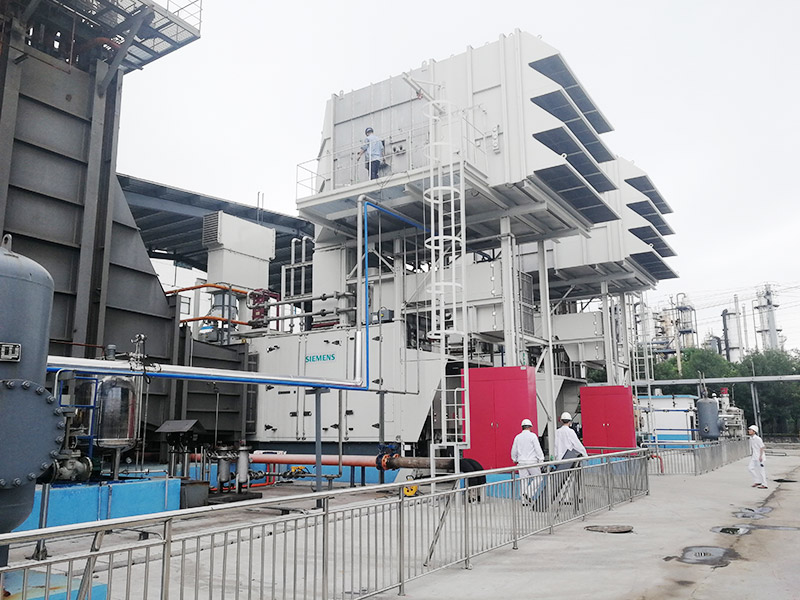
To address the problem of reduced gas turbine output caused by elevated inlet air temperature, the compressor inlet air temperature can be decreased. Our company adopts the spray evaporation cooling method. It features low initial investment, simple equipment and low operation and maintenance costs. In particular, spray evaporative cooling boasts low air intake resistance, the capability to absorb salt and dust in air and auxiliary air purification functions, making it increasingly widely applied.
2.2 Composition of Spray Evaporative Cooling System
The spray evaporative cooling system follows the isenthalpic humidification principle. Demineralized water is sprayed into the gas turbine air intake duct; water mist absorbs sensible heat from air during evaporation and converts it into latent heat of water vapor to lower the inlet air temperature. The spray evaporative cooling air intake system can not only cool intake air but also assist air purification with outstanding salt removal performance, delivering remarkable effects in environments with high air salt content.
The spray evaporative cooling system mainly consists of an evaporation chamber, nozzle assemblies, water mist separators, temperature and humidity sensors, instruments and meters, and a water supply system. Medium-pressure high-efficiency nozzles enable full evaporation of water mist within about 0.5 seconds, while water mist separators efficiently separate unevaporated water, limiting the liquid water content in air to less than 0.5% and meeting the gas turbine’s requirements for water carryover rate.
3. Expected Effects
After installing the evaporative cooling system, the relative humidity of air is expected to rise above 80%, and the expected temperature drop is shown in Table 4. The power generation capacity of the gas turbine can be increased by over 5%. At present, spray evaporative coolers have been successfully applied to multiple gas turbine generator sets domestically, delivering excellent cooling performance in summer with low investment, low operation and maintenance costs and obvious improvement in power generation output. Apart from gas turbine air intake applications, the equipment has also achieved successful results in other scenarios suffering insufficient intake air due to high summer temperatures.
Table 4 Air cooling effect under ambient temperature above 30°C is shown as follows:
| Ambient Relative Humidity | Below 25% | Below 30% | Below 40% | Below 50% | Below 60% |
| Reduced Inlet Air Temperature after Retrofit (℃) | 11–15.9 | 9.8–14.4 | 7.5–10.6 | 5.4–9.1 | 3.5–6.7 |



 0373-7722918